A customer may describe the job as ‘just a small print’ even when no printable model exists. Measuring a broken part, rebuilding geometry, repairing a mesh, testing clearances, preparing variants, and communicating revisions can exceed the printer time by many hours. If all of that work is hidden inside a per-gram price, the most demanding custom orders become the least profitable. Design needs its own scope, rate, and approval point.
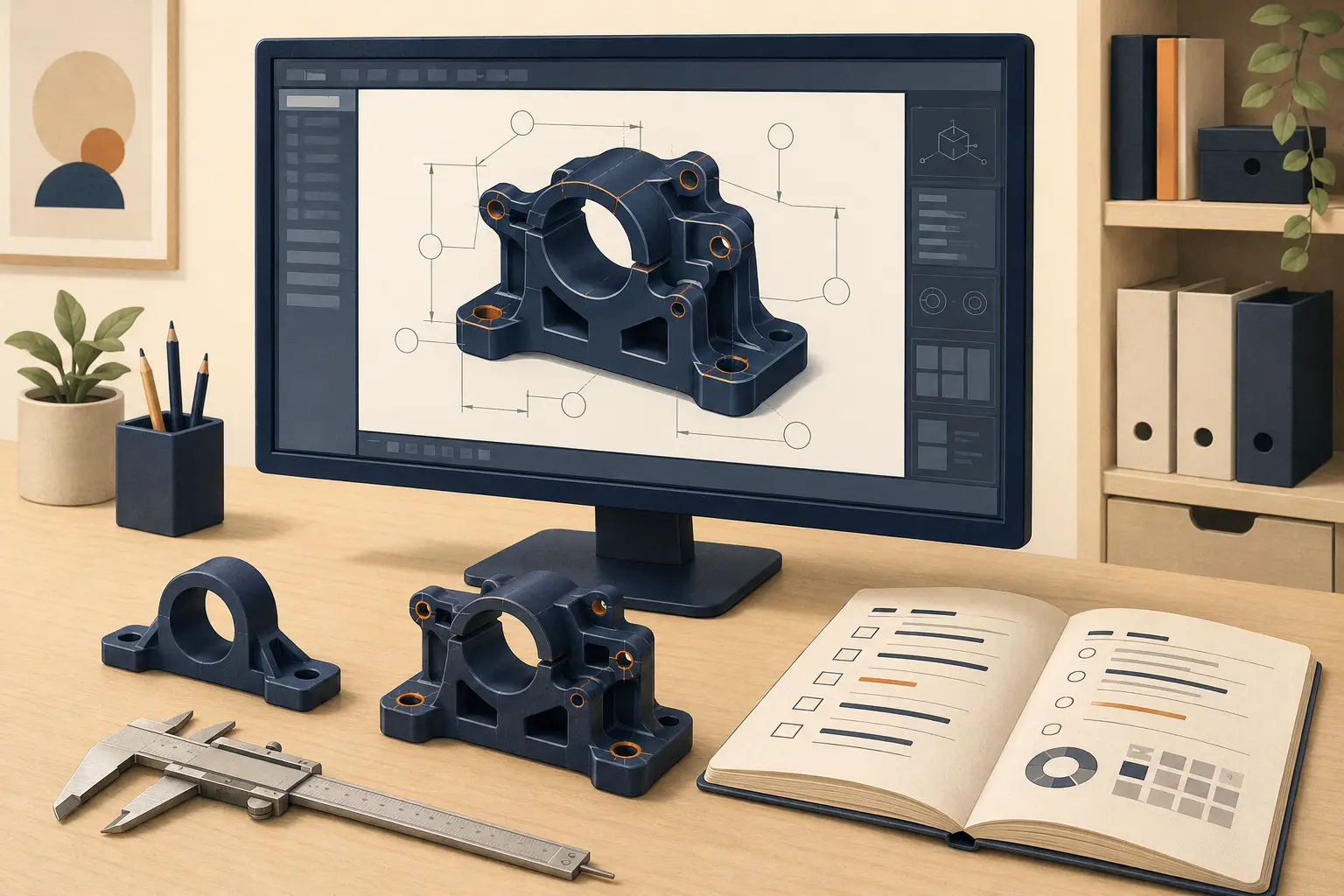
1. Classify the file before promising a design price
A production-ready CAD file, a damaged STL, a dimensioned drawing, a physical sample, and a reference photograph create very different workloads. Ask what the part must do, which dimensions are critical, what it mates with, how many variants are required, and whether the customer expects editable source files. A useful estimate begins with the quality of the inputs.
State assumptions when the requirement is incomplete. You might quote a visual replica that is not certified for structural use, or a fit-check prototype based on dimensions supplied by the customer. Written assumptions prevent a low-cost modeling task from silently expanding into material selection, engineering validation, or reverse engineering that was never priced.
- Input type: printable file, drawing, sample, or photograph.
- Function, environment, critical dimensions, and acceptable tolerance.
- Number of concepts, variants, and included revisions.
- Deliverables: printed part, STL, STEP, native CAD, or drawings.
- Ownership, confidentiality, and future reuse expectations.
2. Break design into billable work blocks
Track discovery, measurement, CAD construction, mesh repair, design-for-print changes, slicing trials, test assembly, documentation, and customer communication separately. This produces better estimates for the next job and shows why two similarly sized prints can have radically different project prices.
Use a minimum design charge for short interruptions. Opening files, checking units, organizing versions, sending previews, and archiving deliverables consume time even when the visible edit takes five minutes. A minimum protects the setup cost while a clear hourly or fixed-project rate gives the customer a predictable decision.
3. Include a defined revision allowance and a formal approval
A fixed quote should state what one revision means. Changing a hole diameter or label location is not equivalent to replacing the mechanism or creating a new size family. Include a specific number of review rounds, describe the changes that fit within them, and price additional changes by time or as a new scope.
Send a dimensioned preview, render, or low-cost test piece for approval before the production run. Once the approved version enters production, customer-requested changes become new work; production defects remain the maker’s responsibility. This boundary reduces arguments over who pays for a print that accurately reproduces a design the customer later changed.
4. Price reusable design value and deliverable rights deliberately
Hourly billing is a useful floor, but it may undervalue a design that solves an expensive problem or can be sold repeatedly. Decide whether the customer buys one printed use, a non-exclusive file license, an exclusive design, or the editable source. Transferring broad rights can justify a higher fee because it removes future commercial options.
Use third-party models, fonts, and components only within their licenses, and explain any restrictions that carry into the deliverable. Keep the customer’s proprietary geometry separate from portfolio work unless permission is explicit. Clear rights are part of a professional quote, not a legal detail to discover after delivery.
5. Combine design, testing, and production without hiding the margin
The project price should include design labor, test prints, production cost, post-processing, packaging, fees, failure allowance, and target profit. Show design and production as separate customer-facing lines when it improves clarity. A repeat order can then omit or reduce the design line while retaining the validated production price.
Compare estimated hours with actual hours after completion. If file repair consistently takes longer than expected, change the intake questions or introduce a paid evaluation stage. Profitable custom work comes from better scoping and repeatable decisions, not from typing faster while absorbing every unknown.
References and further reading
These manufacturer and technical references support the workflow described above. Use them as a starting point, then validate costs and settings in your own workshop.
Test your numbers