Maintenance is not a single annual bill. It is a stream of small parts, cleaning time and occasional lost production. A useful P1S quote separates scheduled work from failures and builds a reserve from your own workload rather than inventing a universal cost per hour.
P1S reserve calculator
Convert a maintenance plan into cost per productive hour
The example values demonstrate the formula. Replace them with your own parts, service-time, repair and productive-hour planning inputs.
maintenance reserve/hour = (parts + supplies + service labor + repair reserve + documented downtime impact) ÷ productive hours
Calculation Model
Build the reserve from a maintenance ledger
Question: What hourly allowance keeps modeled maintenance and downtime from disappearing from a P1S quote?
Bambu Lab documentation defines model-specific procedures. The cost and interval model remains owner-supplied; this site publishes no P1S service-frequency or downtime measurements.
maintenance reserve/hour = (parts + supplies + direct service labor + documented downtime impact) ÷ productive machine hoursVariables
Replace every example input with the job being quoted
| Symbol | Meaning | Unit | Input source |
|---|---|---|---|
| C | Parts and maintenance supplies in the chosen period | currency/period | User-entered purchase and allocation assumptions |
| L | Direct service labor | currency/period | Hands-on minutes × chosen labor rate |
| D | Downtime impact included by policy | currency/period | Use zero unless unavailable time displaces demand |
| H | Productive machine hours in the same period | h/period | Consistent planning period |
Scenario Analysis
Modeled example results
These are arithmetic examples—not measurements, tests, benchmarks, or claims about typical printers. Change the inputs to see which assumption controls the decision.
| Modeled scenario | Inputs changed | Example result | How to read it |
|---|---|---|---|
| Baseline reserve | C = $90; L = $120; D = $60; H = 1,500 h | $0.18 per productive hour | The numerator and denominator cover the same modeled period. |
| Higher utilization | Same $270 cost pool; H = 2,500 h | $0.11 per productive hour | More productive hours spread the same assumed pool more widely. |
| Harsh-use allowance | C = $160; L = $180; D = $100; H = 1,500 h | $0.29 per productive hour | This is a cost scenario, not a claim that abrasive material causes this exact amount. |
| No displaced demand | C = $90; L = $120; D = $0; H = 1,500 h | $0.14 per productive hour | Downtime is excluded when idle capacity means no order or revenue was displaced. |
Assumptions & Limitations
Assumptions to replace
- Official maintenance guidance determines the task; workshop records determine frequency and cost.
- Productive hours exclude idle calendar time and use one documented period.
- Illustrative reserve values are editable examples, not this site's P1S history.
- Printer depreciation and failure loss remain separate unless the quote labels otherwise.
When not to use the result
Where the model can be wrong
- Abrasive materials, dust, utilization, enclosure conditions, or handling change service frequency.
- Warranty replacements or bundled spares are priced as ordinary purchases.
- Downtime is valued as lost revenue without proving displaced demand.
- The same parts, labor, or unavailable hours are counted in two cost lines.
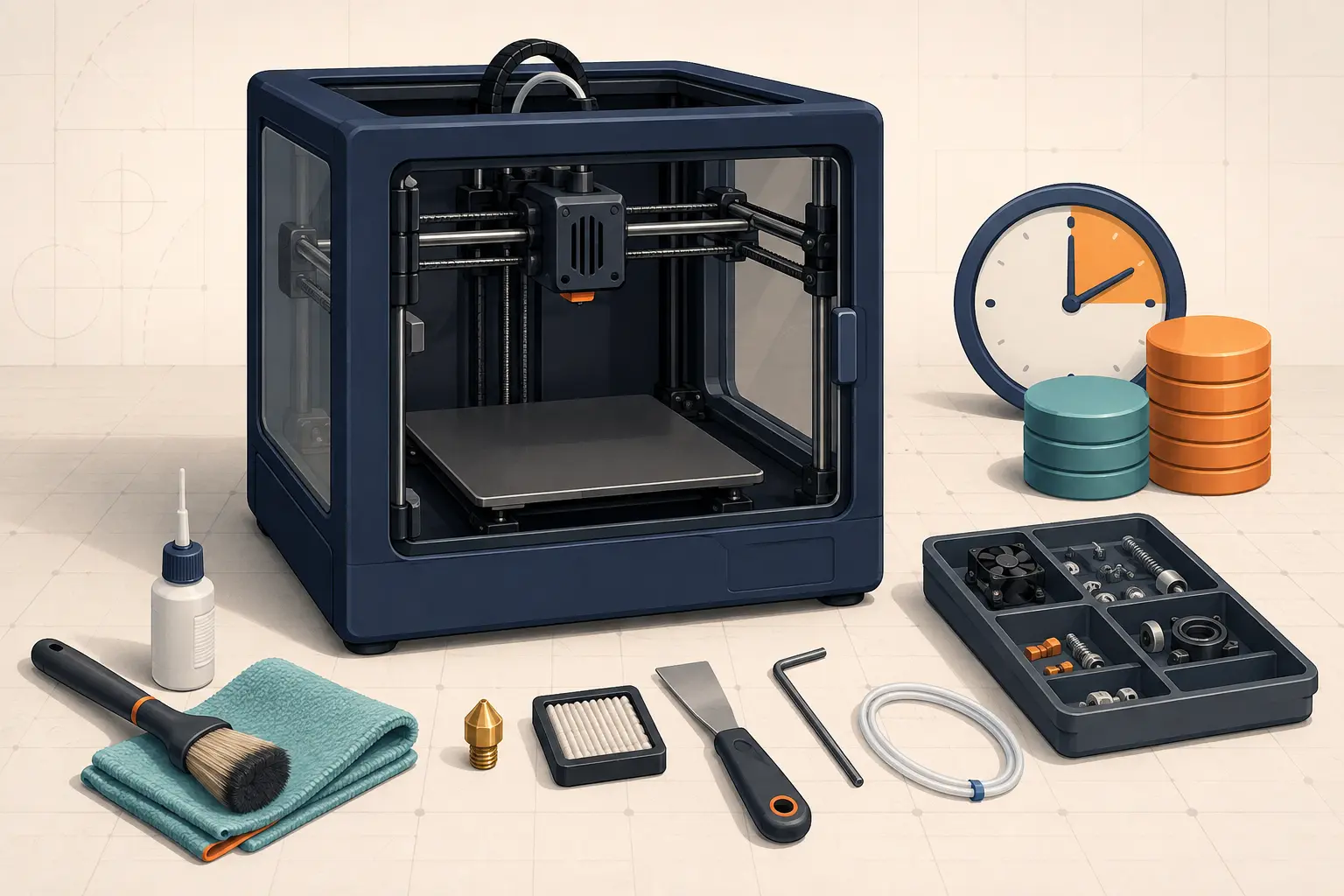
1. Keep five maintenance lines in the cost ledger
Track replacement consumables, cleaning supplies, hands-on service time, unavailable machine time and an unplanned-parts reserve separately. This prevents a nozzle purchase from being confused with printer depreciation and exposes whether labor or interrupted capacity is the larger burden.
The official P1 maintenance guidance should define what is cleaned or lubricated. For example, Bambu Lab states that the X-axis carbon rods are cleaned and do not use lubricant. Follow the current model-specific instructions rather than applying a generic printer routine everywhere.
- Date and operating hours at service
- Part or supply used and landed cost
- Hands-on minutes
- Printer unavailable hours
- Fault symptom and corrective result
2. Turn preventive work into an hourly allowance
Estimate annual or rolling-period cost from work you can plan: cleaning materials, filters and other consumables, replacement wear items, and operator minutes. Divide only by realistic productive machine hours. Calendar time overstates the denominator for a lightly used printer; total powered-on time may include idle periods that do not earn revenue.
Use a maintenance log to replace assumptions. If the printer runs in a dusty space, uses abrasive material or works nearly continuously, its observed interval may differ from a low-use clean environment. The log is evidence for your own allowance, not a claim that every P1S behaves identically.
3. Value downtime only when it displaces useful capacity
Downtime has a direct cost when an order is late, labor waits, a spare machine must take the job, or profitable capacity is lost. It is not automatically equal to the printer's maximum possible revenue for every idle hour. Use the contribution that would realistically have been earned during the affected window.
Record diagnosis, waiting for parts, repair and revalidation separately. Planned cleaning during an otherwise empty period may have almost no opportunity cost, while the same task during a deadline can require overtime or a rerouted build.
4. Worked reserve example without claiming field measurements
Assume a twelve-month ledger contains $90 in wear parts and supplies, six hours of hands-on work valued at $20/hour, and $60 of documented downtime impact across 1,500 productive hours. The modeled pool is $270, or $0.18 per productive hour.
Those values are illustrative, not a report from the site owner's P1S. Your log may be lower or higher. Review the allowance quarterly and keep printer purchase recovery in a separate depreciation or replacement-reserve line.
5. Apply the allowance once and keep exceptional repairs visible
Multiply the hourly allowance by the job's expected machine time. Do not also add the same routine parts as a percentage of material cost. A large exceptional repair can be amortized across a documented future period, but the treatment should remain visible rather than being hidden inside an unexplained markup.
Review rejected prints after service as quality-control evidence. A maintenance action is complete only after the printer returns to an accepted baseline; revalidation material and operator time belong in the event record.
References and further reading
These manufacturer and technical references support the workflow described above. Use them as a starting point, then validate costs and settings in your own workshop.
Test your numbers