An AMS helps manage multiple spools, but it does not make material handling free. Desiccant, sealed overflow storage, drying energy, operator checks and moisture-related failures all belong in inventory cost. The objective is not a universal humidity threshold; it is a documented workflow tied to each material's manufacturer guidance.
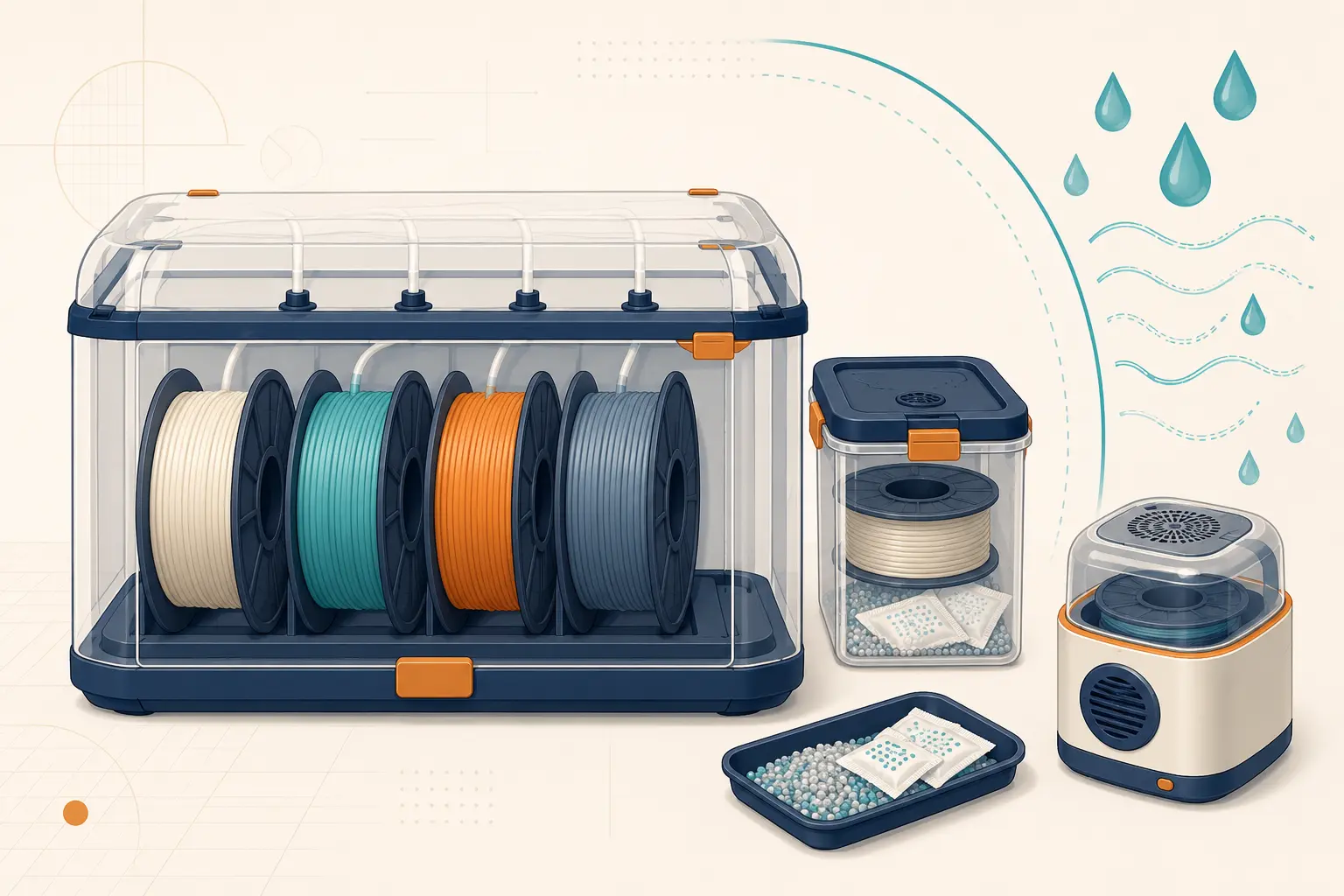
1. Map every spool location, not only the AMS
List spools in the AMS, sealed overflow boxes, a dryer, open staging and partial-spool storage. A dry AMS does not protect inventory left on a shelf. Assign materials to storage conditions based on the current filament manufacturer's guidance and the validated production workflow.
Use the AMS humidity indication as an operational signal within the documented system, not as proof of moisture content inside a spool. Inspect desiccant and seals, and record dates, because an indicator without a response rule does not prevent loss.
- Spool ID, material and opened date
- Current storage location
- Desiccant check or replacement date
- Drying cycle and reason
- Print symptom, result and disposition
2. Separate recurring supplies, equipment and corrective drying
Recurring cost includes desiccant replacement or regeneration, bags and seals, labels, handling time and electricity for drying. Equipment such as sealed boxes or a dryer can be allocated across a realistic service life. Moisture-related failed parts and discarded inventory are loss lines, not ordinary storage supplies.
This separation answers different questions. High recurring supply cost suggests a seal or workflow problem; high corrective-drying time suggests inventory is staying exposed; high reject cost suggests checks are too late or diagnosis is weak.
3. Follow material-specific drying guidance and avoid guesswork
Bambu Lab publishes drying recommendations by filament family. Confirm the exact material and spool compatibility before selecting equipment, temperature or duration. Drying hotter or longer is not automatically safer, and the AMS enclosure should not be treated as a powered dryer unless current manufacturer documentation specifically supports that workflow.
Log the trigger for each cycle: preventive schedule, humidity exposure, visible print symptom or a failed verification print. This makes it possible to distinguish necessary treatment from habitual energy use.
4. Allocate storage cost to the filament actually consumed
Assume a month includes $8 of desiccant and storage supplies, $6 of drying electricity, 45 minutes of handling at $20/hour, $5 of equipment allocation and $16 of documented material loss. The modeled total is $50. If 8 kg is consumed in accepted production, storage overhead is $6.25 per consumed kilogram.
This is a transparent example, not measured AMS performance. A low-volume workshop may allocate per spool-month instead; a production farm may allocate by kilograms consumed. Choose the driver that best explains why the cost occurs and keep moisture-related rejects visible.
5. Use a simple inspect–act–verify loop
Check desiccant status and physical condition on a defined cadence, inspect seals whenever the AMS or container is opened, and move idle spools promptly to suitable sealed storage. Bambu Lab's FAQ suggests regular desiccant checks every two to three weeks, but local humidity, opening frequency and material sensitivity should determine the actual documented routine.
After drying or changing storage, verify with a representative print before releasing a critical batch. The aim is accepted output with less rework—not the lowest possible indicator reading or the largest collection of storage accessories.
References and further reading
These manufacturer and technical references support the workflow described above. Use them as a starting point, then validate costs and settings in your own workshop.
Test your numbers